

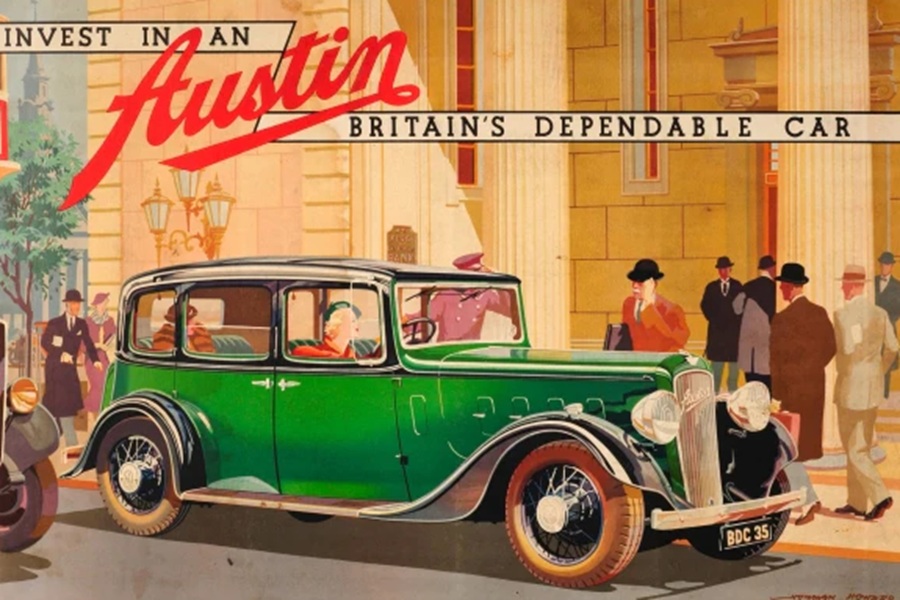
The Golden Age of British Motoring and the Great North Road
The first half of the 20th century saw the motor car transform the roads of Britain. Horses, cyclists and pedestrians had to make way as the internal combustion engine made motorised transport accessible to increasing numbers. Cars, motorbikes, buses and trucks evolved from rudimentary beginnings, opening up new possibilities for travel, business and recreation.
Suddenly, it was possible for people (well some people) to go where they wanted, when they wanted – with whomever they wanted.
An enduring love affair with the motor car was born.
The Great North Road was coated with tarmac, it was renamed the A1, and the first bypasses were built. Some of the old coaching inns, such as the Ram Jam, were re-awakened to serve a new and prosperous clientele. New “roadhouses” appeared. Filling stations and car parks rather than stabling and courtyards were required all the way from London to Edinburgh.
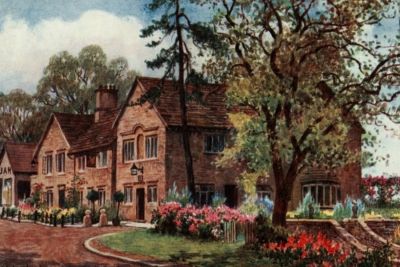
The Ram Jam Inn, Stretton. A 1920s watercolour painting featured on a postcard, artist unknown.
The Great North Road offered a romanticised escape route from the ballooning cities to the great outdoors. And through two world wars it provided essential communications to the munitions factories, airfields, barracks and other military sites of eastern England.
Many aspired to the prestige and personal freedom offered by a motor car though access to this new luxury was largely confined to the wealthiest in society until later in the century.
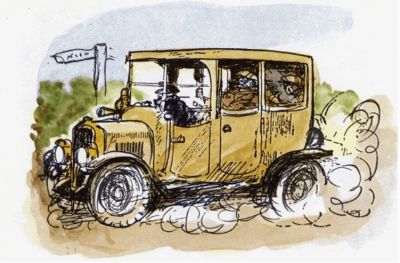
Mr Toad. Image Credit – E H Shepard
Next moment, hardly knowing how it came about, he found he had hold of the handle and was turning it. As the familiar sound broke forth, the old passion seized on Toad and completely mastered him, body and soul. As if in a dream he found himself, somehow, seated in the driver’s seat; as if in a dream, he pulled the lever and swung the car round the yard and out through the archway; and, as if in a dream, all sense of right and wrong, all fear of obvious consequences, seemed temporarily suspended. He increased his pace, and as the car devoured the street and leapt forth on the high road through the open country, he was only conscious that he was Toad once more, Toad at his best and highest, Toad the terror, the traffic-queller, the Lord of the lone trail, before whom all must give way or be smitten into nothingness and everlasting night. He chanted as he flew, and the car responded with sonorous drone; the miles were eaten up under him as he sped he knew not whither, fulfilling his instincts, living his hour, reckless of what might come to him.
Kenneth Grahame, The Wind in the Willows, 1908
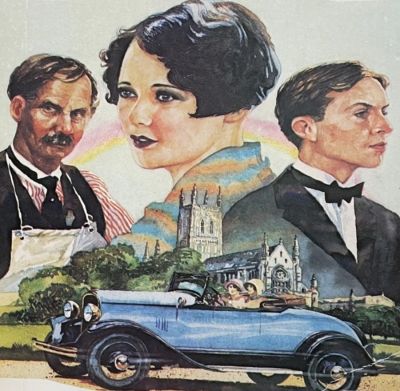
Image Credit – Good Companions book cover from 1980s, Grafton
At one place they had to slow down a little and then Oakroyd read the words painted in large black letters on the whitewashed wall. The Great North Road. They were actually going down The Great North Road. He could have shouted. He didn’t care what happened after this.
JB Priestley, The Good Companions, 1929
The Fantastic Horror of the Cat in the Bag, Dorothy L Sayers:
It is not known why motorists, who sing the joys of the open road, spend so much petrol every week-end grinding their way to Southend and Brighton and Margate, in the stench of each other’s exhausts, one hand on the horn and one foot on the brake, their eyes starting from their orbits in the nerve-racking search for cops, corners, blind turnings, and cross-road suicides. They ride in a baffled fury, hating each other. They arrive with shattered nerves and fight for parking places. They return, blinded by the headlights of fresh arrivals, whom they hate even worse than they hate each other. And all the time the Great North Road winds away like a long, flat, steel-grey ribbon—a surface like a race-track, without traps, without hedges, without side-roads, and without traffic. True, it leads to nowhere in particular; but, after all, one pub is very much like another.
About the Golden Age of British Motoring
Explosive Growth in Car Ownership
In 1900 it is estimated there were fewer than 1,000 cars on Britain’s roads. By 1939 this had grown to about 2 million. [That’s nothing compared to the current figure of over 30m but it still marked a transport revolution.]
Initially cars were expensive toys of the rich. “Motor Cars & Driving” was a book published in 1902 by Lord Northcliffe (and others). It was full of practical advice on what car to buy and how to cope when things went wrong. The usefulness of the motor car was demonstrated by its ability to get you to fox hunts or to Scottish trout lochs. Another essay explained how motoring improves general health.
The easy jolting which occurs when a motor car is driven at a fair speed over the highway conduces to a healthy agitation; it “acts on the liver” which means only that it aids the peristaltic movements of the bowels and promotes the performance of their functions.
The motoring “influencers” of the day included Field Marshall Lord Roberts, Rudyard Kipling and Winston Churchill.
As mass production was introduced and prices fell so the more basic models became accessible to the middle classes. Hire purchase options were increasingly available.
Designs of the times
The engineering and design of cars evolved rapidly with many of the earliest manufacturers soon falling by the wayside. While functionality, reliability and cost were essential, it was styling, comfort and fashion which were increasingly important. “Art Deco” designs became fashionable, featuring sloping windscreens, sweeping wings, curved roof lines and pillar free windows.
Cars were always a very visible status symbol and, as is the case today, your choice of car said much about your wealth and aspirations.
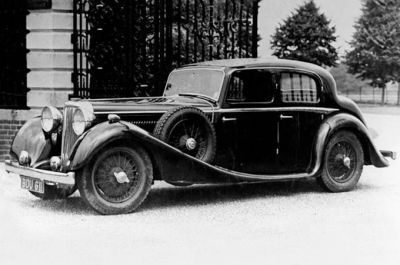
1935 SS Jaguar 2.5l Saloon. The first Jaguar. £390. Image Credit – Jaguar
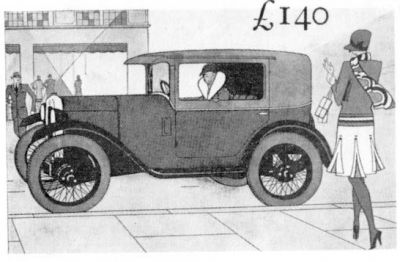
Austin 7. “The first small car ever designed to give the woman driver everything she wants”.
Join the Club
Car ownership was a privilege – you were joining an exclusive club. The Automobile Club (Royal from 1907) had been established in 1897 to promote the interests of motorists and to sponsor motor sports. The Automobile Association broke away from the Automobile Club in 1905 campaigning for higher speeds and providing warnings to motorists of speed traps.
These membership organisations went on to play a central role in 20th century motoring.
In 1900 the Automobile Club organised a groundbreaking 1,000-mile reliability trial from London to Edinburgh and back, aimed at proving the reliability of motor cars to a sceptical public.
The uniformed AA patrolmen and RAC scouts provided breakdown assistance to motorists plagued with unreliable cars and roads of highly variable quality. They moved on from bikes to use motorbikes and sidecar combinations. As well as helping stranded members, patrolmen were often actively involved in traffic management.
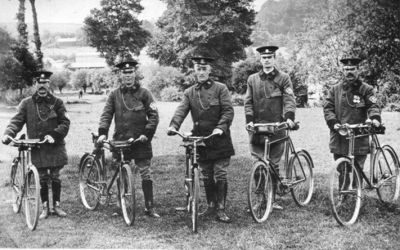
AA patrols with their bicycles, 1914. Image Credit: Automobile Association
Roadside sentry boxes appeared from 1912. Initially providing shelter for the patrolmen, by the 1920s they came to include emergency telephones which members could access with the key provided to them.
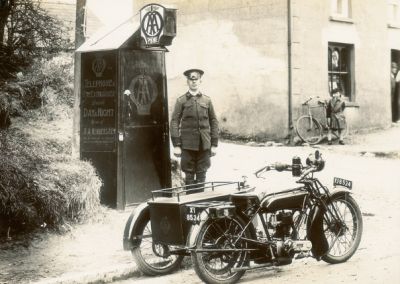
1920s roadside telephone box. Image Credit – Automobile Association
The RAC and AA provided other important services to motorists including insurance, hotel directories, and touring guides.
Another institution known to all UK motorists of the early 20th century was the journal, Autocar, launched in 1895.
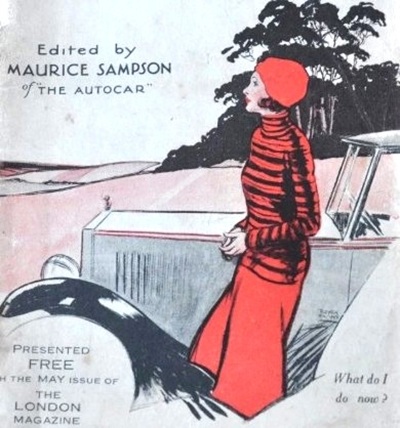
The London Magazine provided a free “Motoring Handbook” supplement in 1931. It included extensive practical motoring advice for the worried young lady wondering “What do I do now?”.
The Joy of Speed
The pursuit of speed is nothing new and of course it was in 1896 that the Olympic Games were revived and in 1908 they were first held in Britain. Horses, coaches and then trains had been coaxed faster and faster to diminish the time taken to travel across the country. But more than this, there was a deep-rooted passion for speed in early 20th century Britain. The economy might be struggling and the empire starting to wain but we had the engineering genius and the plucky characters to break world speed records for cars, trains, boats and planes.
All kinds of motor racing proved popular. The RAC held the first Tourist Trophy in 1905, promoted first British Grand Prix at Brooklands in 1926 and the first Grand Prix d’Europe at Silverstone in 1950.
The speed limit for cars was initially 4mph but in 1896 the government had changed the law to allow motorists “the freedom of the road” – and the right to drive at up to 20mph. This nominal speed limit remained but with most cars of the late 1920s capable of around 70mph it was very widely ignored. Transport Minister, Herbert Morrison concluded:
as legislators we are not entitled to enforce and to continue speed limits which we ourselves have no intention of observing
In any case, enforcement was problematic. It relied on officers working in pairs using stop watches, with offenders caught by a third policeman who would stand in the road on receiving a signal from the others.
The speed limit was abolished completely in 1930 but faced with a spiralling number of accidents and fatalities (half of them pedestrians) the government introduced a speed limit of 30mph for built-up areas in 1934.
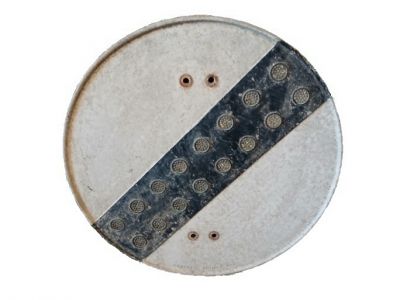
This signalled end of speed restriction – not today’s “national speed limit applies”!
Driving Standards and Regulation
Driving standards and behaviour attracted considerable attention. Prime minister Stanley Baldwin in 1927 (when opening the Kingston bypass) argued for:
An unwritten code that to defile any of these great roads, either by ugly surroundings, by hoggish behaviour along them, or by upsetting or spilling litter on them, should be a bar to a man from entering any decent club or any decent home circle.
Lord Cottenham wrote on the subject in the Daily Express and spoke on radio:
Where the Rolls Royce, the Daimler, or the Sunbeam in days gone by might have been occupied by those to whom the well-being of their tenants and their servants was as important as the upbringing of their own children, today those cars are occupied far too often by the war profiteer or the nouveau riche.
Colonel Mervyn O’Gorman of the RAC opposed suggestions for a driving test saying the most important quality in a driver was “a road sense for which a man could not be examined”. He urged controls on impulsive pedestrians including a requirement to only cross the road at right angles and at marked places. O’Gorman did help develop the Highway Code which was first published in 1931.
By 1934 the number of fatalities was in excess of 7,000, gentlemanly behaviour was not enough and there was growing pressure for regulation. As well as re-introducing speed limits in built-up areas, a new Road Traffic Act introduced a compulsory driving test. There’s a helpful video for learner drivers produced in 1935 by Ford and Pathe.
In 1937 it was even required that new cars be fitted with a speedometer.
Increased regulation may have helped but, compared to today, road users (drivers, passengers and pedestrians) were at much greater risk. A good example was on the Great North Road at Stilton where a straight section, up to 20m wide with no lane markings, saw regular high speed and erratic driving. In December 1936 Harry Spriggs, son of a former Bell innkeeper, collided with a car and was fatally injured; it was Stilton’s third death on the road in 2 months.
Touring & Sight Seeing
Newspapers, maps and guidebooks all offered new opportunities to explore Britain and Europe to an extent not previously possible.
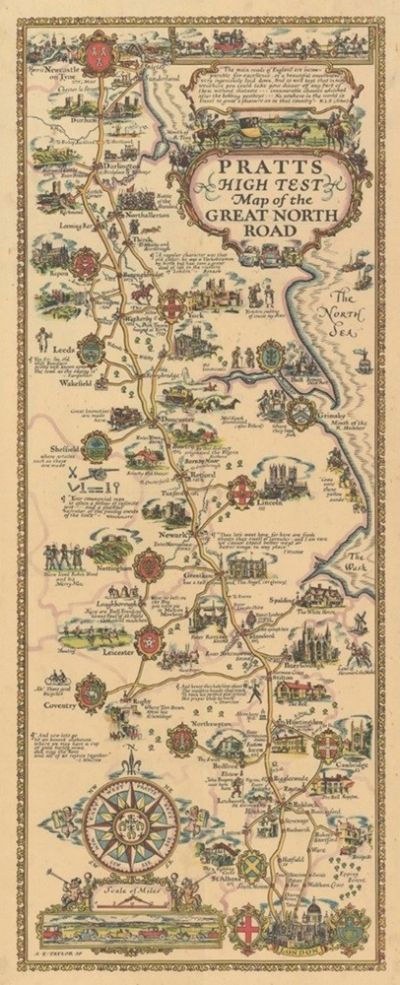
The High Test map of the Great North Road was produced in 1930 by Anglo American Oil and was available free on application to their offices. Their petrol brand changed name from Pratt’s to Esso in 1934.
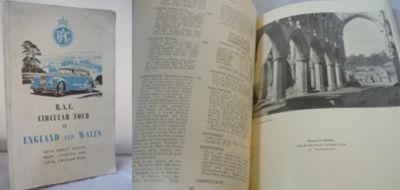
Motoring guide books introduced countless opportunities for touring and tourism. This RAC guide included popular Yorkshire location, Fountains Abbey
Harrogate was a popular draw for travellers using the A1.
In an endeavour to let Harrogate’s proximity to the Great North Road be generally known a new booklet entitled “Harrogate for the Motorist” has been compiled by that spa’s publicity department, giving, amongst other information, a list of hotel and garage accommodation with short-stay prices.
Motorists doing the journey from London to Edinburgh, or vice versa, can by a slight detour at Wetherby from the south and Boroughbridge from the north break their journey overnight.
The Travel Editor, The Queen, 1931
A rare total eclipse of the sun stimulated great interest and mayhem on the roads. The line of totality ran through Hartlepool, Darlington and the Yorkshire Dales.
Motor traffic on the Great North Road, heavy at any time, became an almost endless procession yesterday, and continued late into the evening, thousands of Londoners travelling north to see the eclipse. Scouts and patrols of the Automobile Association and the Royal Automobile Club, greatly reinforced in numbers, were besieged with questions, and by means of specially prepared road-maps were able to indicate at a glance the shortest and best route for motorists.
One car was equipped with an elaborate wireless set with which it was proposed to test if the eclipse had any effect on wireless reception. Other cars carried portable gramophones to entertain the parties.
Sheffield Daily Telegraph, 29 June 1927
It was not of course just about private cars. Charabancs took groups to the seaside and coach companies offered new, more economic ways to explore the country.
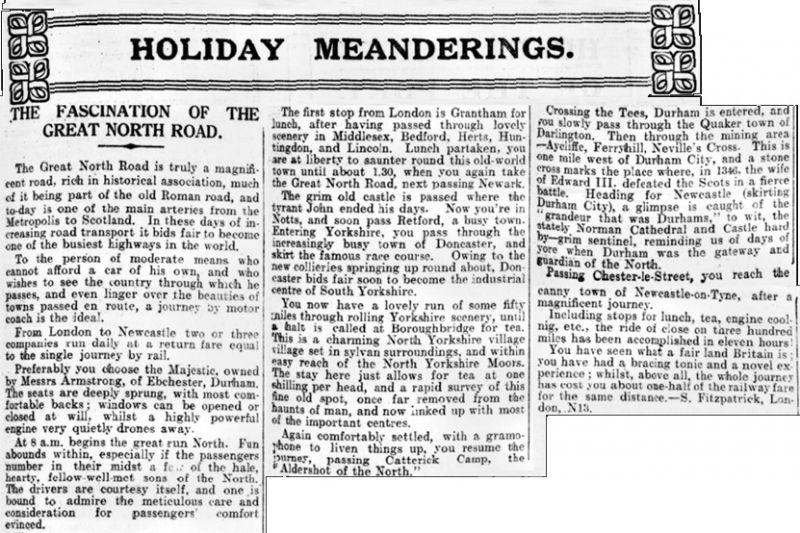
Northern Weekly Gazette – Saturday 1st September 1928
Roads & Infrastructure
There had been experiments with the application of tar to road surfaces since the mid-19th century but it was only in the early years of the 20th century that asphalt was regularly used. Motor traffic quickly destroyed the “water bound” surfaces of the past.
Motorists had to be very mindful of surfaces as they were far from uniform. Tarmacadam became the norm for major roads but other routes might simply have gravel bound into a thin layer of tar. In towns there were often stone cobbles and wooden blocks, with the added challenge of driving narrow tyred vehicles across slippery tram tracks. Factor in oil drips, horse droppings, poor drainage and solid or bald tyres and there is little wonder that serious skidding was a routine hazard.
Perhaps inspired by the mighty railway network of the previous half century there was no shortage of vision as to how roads might develop. In 1900 Arthur Balfour advocated “great highways …. confined to the carriage of motor traffic”. The word “motorway” was first used in parliament as early as 1924. However, when it came to road building and improvement Britain consistently lagged behind its European neighbours – particularly the fascist states. A 1937 Nazi propaganda film, “Schnelle Strassen” showed a group of British tourists captivated by a drive on the new autobahns: this You Tube video gives a flavour of the competition:
In Britain we had to make do with incremental improvements. Particularly notable with respect to the Great North Road were the bypasses leading north from London past Barnet and on to the new Garden Cities of Welwyn and Letchworth. Further north bottlenecks such as the narrow bridge at Wansford were being tackled.
GREAT NORTH ROAD
£100,000 For Improvements.
Travellers on the Great North Road will remember that seven miles before reaching Stamford on their northward journey progress is checked the level crossing adjoining Wansford Station. A mile further on as the River Nene comes into sight the road swerves to the left, and threads an awkward course through the ancient village of Wansford with its historic bridge. After this the traveller approaches a notorious cross road thickly beset with walls and obscuring buildings. These dangers passed the road lies open to Stamford.
It is the policy of the Minister of Transport to eliminate these by no means rare groups of obstacles speedily as possible, and it was announced last evening that the level crossing at Wansford will superseded by a bridge over tbe railway. On the outskirts of the village a new road will bend away slightly to the right, crossing the Nene by new bridge and rejoining the old highway beyond the dangerous cross roads referred to.
The total expenditure will be upwards of £100,000, and it is hoped that the work will be begun before the Spring.
Western Daily Press, January 1925.
The bypass was opened in late 1929.
In the mid-1920s white lines started to be painted down the middle of roads to separate traffic, first at dangerous bends but then on open stretches of road. The white line man became a symbol of increasing state control over everyday life. The writer Sidney Jones complained in 1936 that village life was being transformed as gaily painted petrol devices have displaced the old parish pumps and white lines on the road point to an outer world beyond.
An early experiment with a form of traffic lights was pioneered on the Great North Road in North London in 1927. Before then busy junctions in towns were sometimes controlled by a policeman on “point duty” wearing white gauntlets; he would stand in the middle of the junction directing the traffic by hand signals.
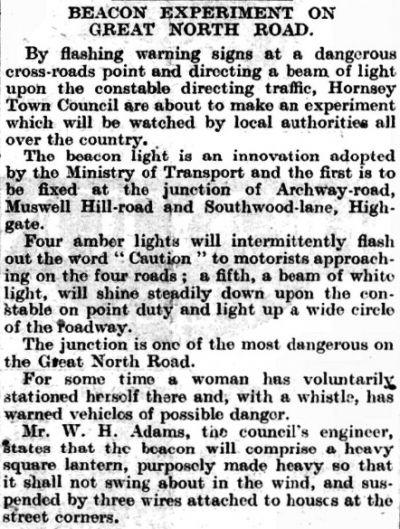
Shepton Mallet Journal, November 1927
Cat’s Eyes, reflective devices fitted into road surfaces, were invented by Percy Shaw in 1933. In the same year the government established the Road Research Laboratory: it went on to study traffic flow, vehicle safety and road surfaces; its work led to the introduction of Belisha beacons in 1934 to mark a pedestrian crossings, then zebra crossings in 1949.
Signposts were generally in the form of the pointing arms still seen on minor country roads – not the flat board type used today.
Leyland clocks were erected in prominent roadside positions around the country in the 1930s and became well known landmarks in their own right. Two of the seven were alongside the Great North Road – one on Vinegar Hill near Alconbury and another at Healam Bridge near Leeming .
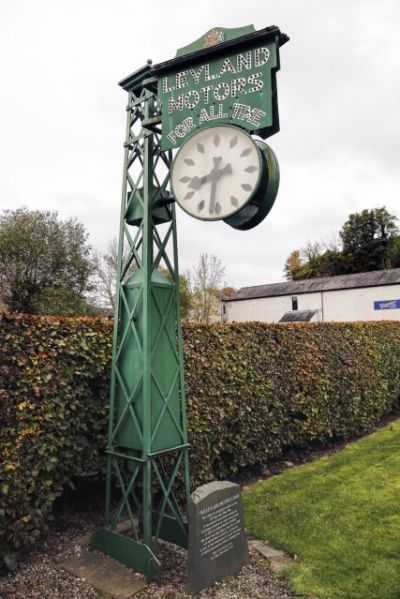
A restored example at the Kendal Brewery Arts Centre
Roadhouses of the 1920s and 1930s
A new breed of roadside hospitality establishment started to appear from the late 1920s. Roadhouses were not simply pubs – in fact some did not even have a licence (though you could bring your own). They did provide other refreshments, food and other recreational activities, often including a swimming pool. They were typically located on busy roads and provided extensive car parking for their customers.
They first appeared on the routes radiating from London. Three famous roadhouses on the Great North Road were The Thatched Barn at Boreham Wood, the Comet at Hatfield and the Clock at Welwyn.
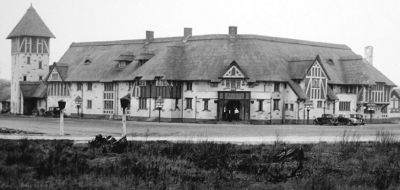
The Thatched Barn was a two-storey mock-Tudor hotel which opened in 1934 on the Barnet by-pass. Including a large dining area and a swimming pool, its facilities attracted customers from affluent north London as well as the flourishing nearby film studios. [It was later bought by holiday camps’ founder Billy Butlin.]
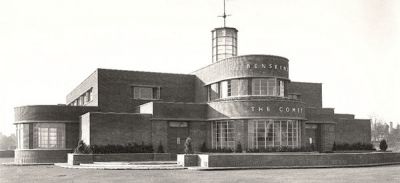
Image Credit – Comet Hotel
The Comet was built in 1933 by Benskin’s Watford brewery in the “Moderne” style. It was named after the locally built de Havilland Comet DH88 racing aeroplane. The building’s architect, EB Musman, explained it was preferable to “arrange your parking all round the house, as the motorist, who thinks of stopping for a drink, would prefer to park his car near to the bar he wishes to enter.” [The first legally enforceable maximum alcohol levels were not introduced until 1967.]
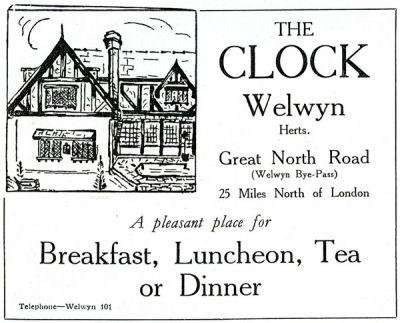
The Clock started in the late 1920s as a petrol station and repair shop; then came a café serving inexpensive meals; then a ballroom, swimming pool and a group of “small, chic bungalows” were all added.
Chains of roadhouses started to be established across the country. A “Knights on the Road” outlet was established on the new Wansford bypass in 1932; it later operated as a Little Chef.
Roadhouses were part of a wider trend during the interwar years towards larger, more controlled drinking establishments following serious concern about the drinking habits of the masses. In 1915 Lloyd George had declared:
We are fighting Germany, Austria, and Drink, and so far as I can see, the greatest of these deadly foes is Drink.
Ironically, roadhouses themselves started to face criticism in the 1930s. There were newspaper stories claiming they were dens of sleaze, drug taking and prostitution. In 1937 a short story by mystery crime writer Valentine William featured a fictional roadhouse on the Great North Road: two people were found dead – a married stockbroker and his lover, an entertainer at the roadhouse who had numerous “gentlemen friends”.
More Information about the Golden Age of British Motoring
British Cars of the 1920s & 1930s – a You Tube video by Richard Jones
London to Grantham film – 1939
1934 Journey from Land’s End to John O’Groats, Ford / National Motor Museum
The Life & Death of the Interwar Roadhouse, David Gutzke, Brewery History Journal, 2017
The Golden Age of British Motoring – Photos by WJ (Bill) Brunell collated by Roy Bacon, 1995 (examples below)
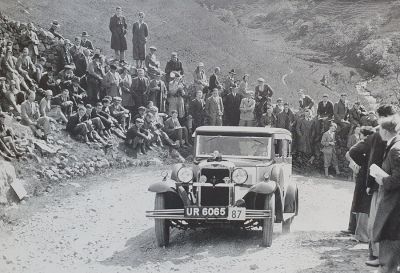
A Lagonda makes light work of the rough surface and steep climb at Park Rash near Kettlewell during the 1930 London to Edinburgh trial.
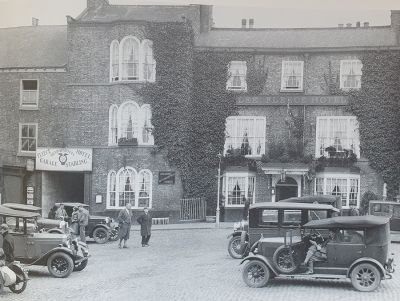
The Fleece Hotel in Thirsk (advertising both garaging and stabling!) being visited by cars taking part in an Ilkley Club trial.
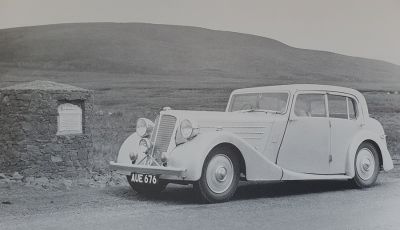
Memorial to the Edinburgh mail coach guard and driver who lost their lives in an 1831 snowstorm at Tweedsmuir. The car is a Standard Flying Six.
Top of page image:
Advertising poster for Austin cars by Norman Howard