

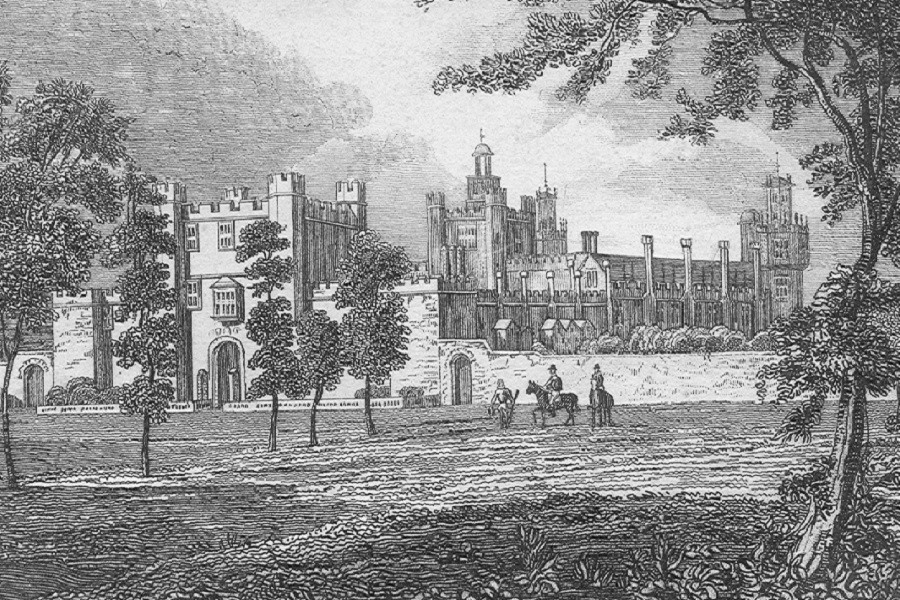
Theobalds Palace and the Great North Road
Theobalds Palace was located close to the Old North Road between Waltham Cross and Cheshunt.
Constructed by William Cecil it was visited many times by royalty – and was indeed later owned by Stuart monarchs.
One of the great Elizabethan houses, it was less than a 3-hour horse ride from London – an ideal retreat from the hustle, bustle, stress, dirt and grime of the city.
The legacy of a country park remains near the intersection of the A10 and M25 but the house itself was ephemeral and is long gone.
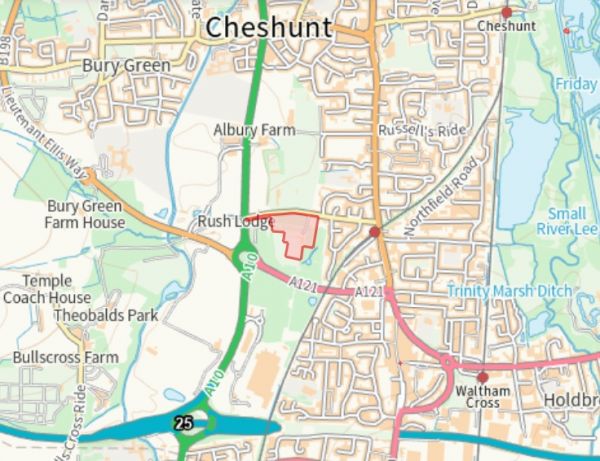
The scheduled monument (outlined in red) lies between the modern A10 and the Old North Road. Theobalds Grove station is located where the main driveway to the house turned off the north road. Image Credit – Ordnance Survey
About Theobalds Palace
The grand palatial home of Theobalds (pronounced “Tibbles”) was in existence for about 100 years from the mid-16th to the mid-17th centuries when it was dismantled by Oliver Cromwell.
There was a moated manor house before this and later several large houses occupied the site. A substantial part of one of these, the Cedars, remains along with fragments of another, Old Palace House (which had re-used elements of the original palace).
Theobalds – Timeline
1383
A substantial house is already in existence when the estate is passed to William de Tongge and renamed Tongs.
1440s
First record of the house being called Thebaudes (Theobalds). In 1441 the manor was granted to John Carpenter and his son.
1563
Sir William Cecil purchases the Theobalds estate from a London mercer and begins building a mansion.
1580s
The grand house is completed and is already receiving regular royal visits. Cecil, now Baron Burghley, buys a neighbouring manor in order to expand the Theobalds estate.
1598
Sir William Cecil dies and Theobalds is inherited by his son Robert who was later to become the Earl of Salisbury.
1603
James I visits Theobalds on his journey from Edinburgh to London, en route for his formal coronation.
1607
Robert Cecil exchanges Theobalds with James I for Hatfield House (officially, the property was passed to Queen Anne). Cecil continues to be involved in changes to the building and gardens.
1620
The King has a brick wall built around the estate which he has enlarged to some 2,500 acres through the acquisition of neighbouring land including Cheshunt Park.
1625
James I dies at Theobalds. His son, Charles I, inherits Theobalds.
1650
A parliamentary survey advises that the estate is in excellent condition yet Oliver Cromwell’s Parliamentarians tear down the palace.
1760s
After several ownership changes George Prescott builds a new residence 1km to the southwest, whilst on the old palace site 4 brick houses are constructed (Theobalds Square).
1921
Having been in the hands of the Meux brewing family for over a hundred years the estate is donated to the Cheshunt Urban District Council and then opened to the public.
1924
The new Cambridge Arterial Road divides the estate with the original palace site and surrounding parkland (Cedars Park) located to its east.
Amongst the Largest Houses in England
As a piece of architecture, Theobalds has much to claim that it was, with the possible exception of Longleat and Wollaton, the most important architectural adventure of the whole of Elizabeth’s reign.
Sir John Summerson
Features including balconies and compass windows made some of their earliest documented appearances in English architecture and there were unrivalled numbers of loggias, long galleries and rooftop walks. The architectural fashions of Theobalds were imitated in many other late 16th and early 17th century buildings, including Audley End and Hatfield House.
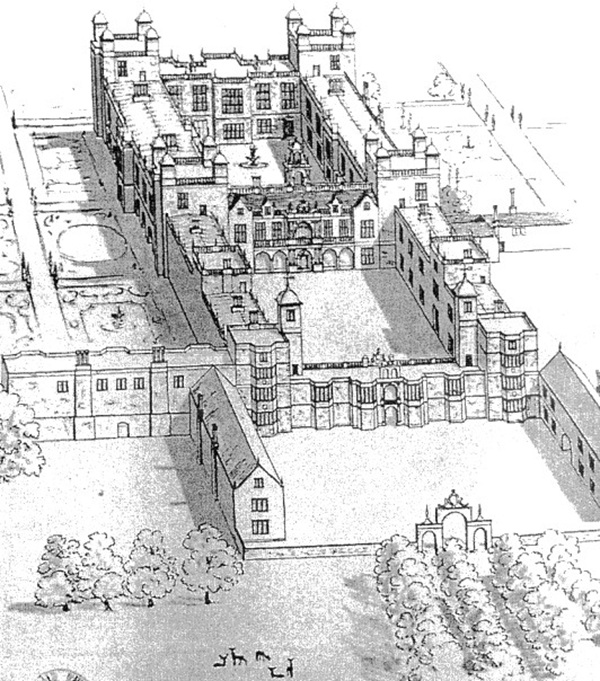
A reconstruction of the Theobalds Palace as seen from the from the east based on Sir John Summerson’s research
The palace was approached by a driveway leading from the London-Ware Road where there were stables and almshouses. Baron Waldstein visiting in 1600 describes the gateway as incorporating a container constructed to look like a bunch of grapes, from which one could draw white wine from one side and red from the other when the queen was present.
There were small lakes to the west and east of the palace, with interconnecting canals marking all but the north sides of the gardens. Waldstein admired a fountain in the form of a ship floating in water, complete with flags and sails.
The main gatehouse led into the first of two courtyards around which the house was arranged. Though on a slightly smaller scale, this layout echoes that of Hampton Court.
By the end of the 16th century the inner “Conduit Court” featured a fountain incorporating figures of Cupid and Venus; according to the Parliamentary survey the fountain was visible from the Ware Road when the gates were open. The black and white marble of the fountain was carried on into the new state rooms.
To the south side of the inner court was the Great Chamber which looked out on the Great Garden. To the west was Great Gallery looking out over the Maze Garden.
In the Open Gallery or loggia of the garden front was depicted the history of England with kings and battles, the Cecil family coming out prominently. The ceiling of the Presence Chamber above this was a working model of the solar system, the walls divided by oak trees in relief, with real bark, and the shields of nobility and officers of state hanging from their branches. In the Great Gallery was a pictorial gazetteer of the world… whilst in the Green Gallery the counties of England were similarly displayed with the heraldry of the lords and gentry.
Sir John Summerson
The Green Gallery was one of the features which received close personal design input by William Cecil and is thought to have reflected his own sketch (below) where trees were hung with the coats of arms and banners bearing the names of various Cecils. The scheme also included cartographic information; Cecil was a keen supporter of Christopher Saxton who produced a series of 35 maps of England and Wales in the 1570s.
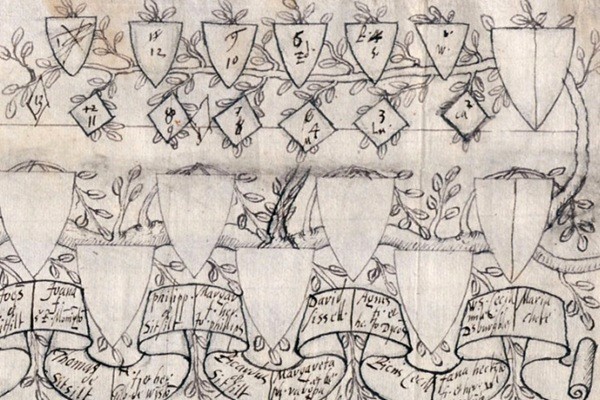
Detail of a drawing by Lord Burghley showing the genealogy of the Cecils depicted on shields and banners hung on branches. Image Credit – Marquess of Salisbury
The journals of Abram Booth describe Theobalds in 1629 as:
large and magnificently built, with two square courtyards, many notable halls, chambers, and parlours. [It] has a pleasant garden adjacent with fountains and lovely walks and an agreeable summerhouse which is built very neatly and elegantly – and made comfortable – from where there is a fine view of the house, garden, and gamepark. The adjacent gamepark is the largest in the whole of England, enclosed by a brick wall more than ten miles long and stocked with many big game.
The layout and appearance of the Elizabethan palace has been reconstructed with the input of both historic documents and archaeology.
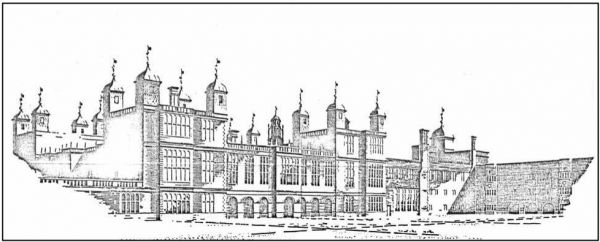
Reconstruction of Theobalds by Malcom Higgs. View from The Great Garden (south-west)
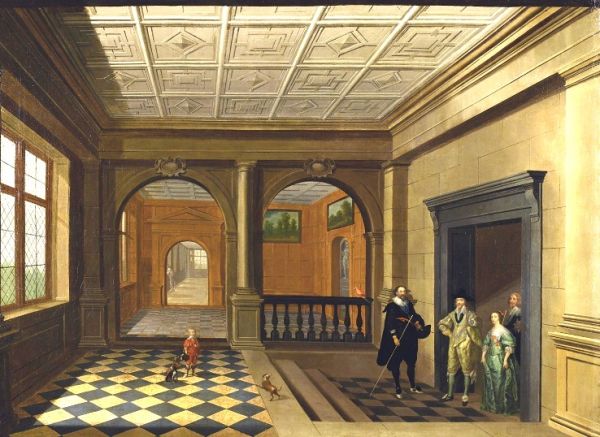
Possibly the Great Gallery at Theobalds from a 1630s painting ascribed to Hendrick van Steenwyck. It includes King Charles I and Queen Henrietta Maria as well as the court dwarf Jeffrey Hudson. Image Credit – UK Government Art Collection.
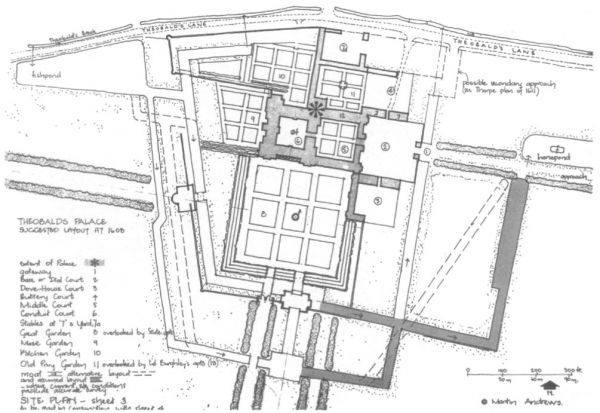
Palace and gardens as suggested by Thorpe Survey of 1608. Image Credit – Martin Andrews
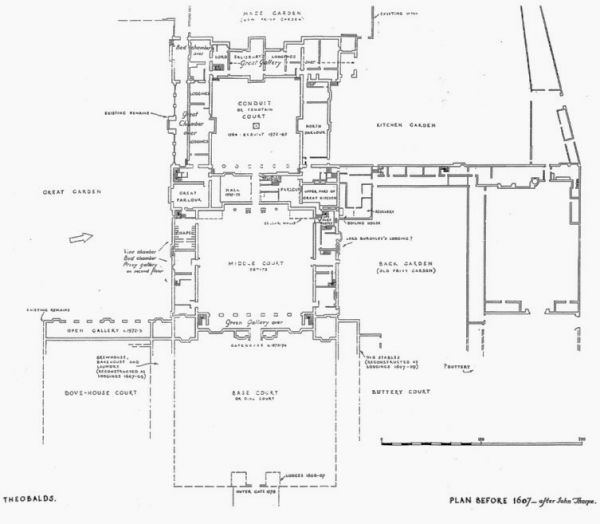
Plan of Theobalds before 1607 – after John Thorpe (eastern approach at bottom)
Very little of the Palace survives though there is a 10m section of the west red brick wall with stone dressings and including the remains of one window.
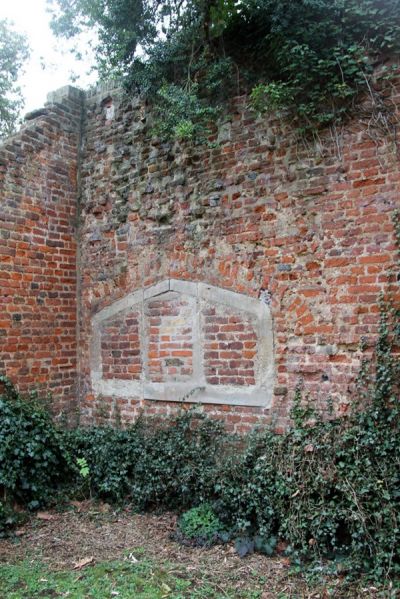
Image Credit – Christine Matthews, CC BY-SA 2.0
The great staircase with oak carvings similar those at Hatfield House was salvaged and eventually installed at Herstmonceux Castle.
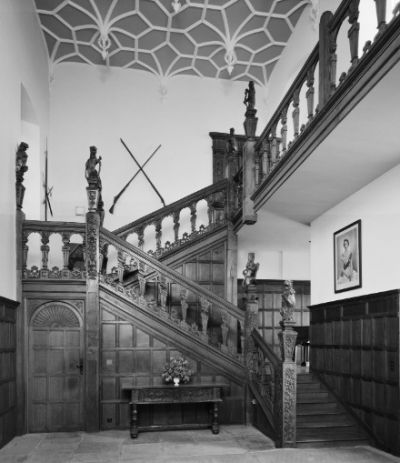
Image Credit: Historic England
Theobald Palace – Royal Visits
By the 1560s William Cecil enjoyed an increasingly influential position at the royal court and in building Theobalds was motivated to create a house and estate which was fitting for royal visitors. Queen Elizabeth first visited in 1564, before the construction of the new palace. She went on to visit more than 10 times between 1572 and 1597, sometimes staying for a week or more, sometimes presiding over Privy Council meetings. An elaborate entertainment “The Hermit’s Welcome” was performed for the Queen in 1591; this visit incurred expenses of over £1,000, whilst another in 1593 cost £2,500.
In 1603 following the Queen’s death, Robert Cecil ensured that as James made his procession south from Edinburgh, he stayed for 4 days at Theobalds and was received by the royal household and court. He, too, was enamoured with the house and in 1607 persuaded Cecil to part with Theobalds in exchange for Hatfield Palace. James presented Theobalds to Anne of Denmark amidst court festivities including a masque, hunting and tournaments.
Anne’s husband, Christian IV, had been hosted by James at Theobald’s the previous year. Apparently, it was a 5-day event which degenerated into much heavy drinking and farcical entertainment.
James I regularly used Theobalds as his country retreat where he would entertain and hunt with international noblemen including Johann Ernst I, Duke of Saxe-Weimar, and Polish-Lithuanian nobleman Tomasz Zamoyski. James set up a menagerie in the grounds, which included elephants and camels. A grand banqueting house designed by Indigo Jones with fountains and painted ceilings was added.
King James I made the Palace his home during his final years, dying there after a string of severe illnesses in 1625. The accession of his son Charles was proclaimed at the gates and the estate passed to the new king.
Charles had spent much of his childhood at Theobalds but as king he perhaps had too many other distractions to spend as much time there as his father. However, it was from Theobalds that he commenced his march to Nottingham on 3rd March 1642 at the start of the English Civil War.
More Information about Theobalds Palace
Theobalds Palace: The Gardens and Park, Martin Andrews, Garden History, 1993
Archaeological Investigation and Recording of Structural Remains, Oxford Archaeology, 2008
Theobalds: The Plan and Interiors of an Elizabethan Country House, Emily Cole, 2017
Top of page image:
The Palace of Theobalds, Gentleman’s Magazine, 1836
BUT PERHAPS NOT – I am told it was wrongly labelled in the magazine! (It in fact depicts Nonsuch Palace.)